· Paul Chessini · 10 min read
Complete Chess Terms List & Glossary

Chess is a game, and it is also a language. Whether you are a beginner looking for chess terminology and definitions or an experienced player filling gaps in your vocabulary, knowing the right words makes it easier to study, follow commentary and talk through a game afterwards.
This chess terms list gives plain-English definitions with short examples, plus the expressions and slang you will hear at tournaments and online. Are you a beginner? Warm up with our tips on chess tips for beginners.

What Are Chess Terms and Why They Matter
Chess terminology lets players say exactly what they mean: the names of moves such as check, capture and promotion, and tactical ideas such as fork, pin and skewer. Knowing them makes lessons, notation and live commentary far easier to follow.
A shared vocabulary speeds up improvement, makes books and streams easier to use, and lets you discuss games with a coach or club mates. The rules themselves are in the FIDE Laws of Chess, which is the official rulebook.
Complete Chess Terms List (A–Z)
An A–Z of chess terms with short definitions and examples. Bookmark it and come back as your game grows.
A
- Activity — Piece mobility and influence. “White improved activity before the endgame.”
- Advantage — A better position (material, structure, or initiative).
- Algebraic notation — Standard system to record moves (e.g., Nf3, exd5). Learn more in what is algebraic chess notation.
- Attack — Coordinated pressure on a target (king, square, or weakness).
- Automatic move — A natural-looking move played quickly, sometimes without calculation, and sometimes wrong.
B
- Back rank mate — Mate on the first/last rank when the king is boxed by its own pawns.
- Battery — Lining up two pieces (often queen + bishop/rook) on a file/diagonal.
- Blitz — Fast time-control chess. See what is blitz chess.
- Blunder — A grave error that significantly alters the assessment.
- Book — Opening theory; “This line is still book.”
- Break (pawn break) — A pawn move that challenges the centre or the opponent’s structure, such as …c5 or f4.
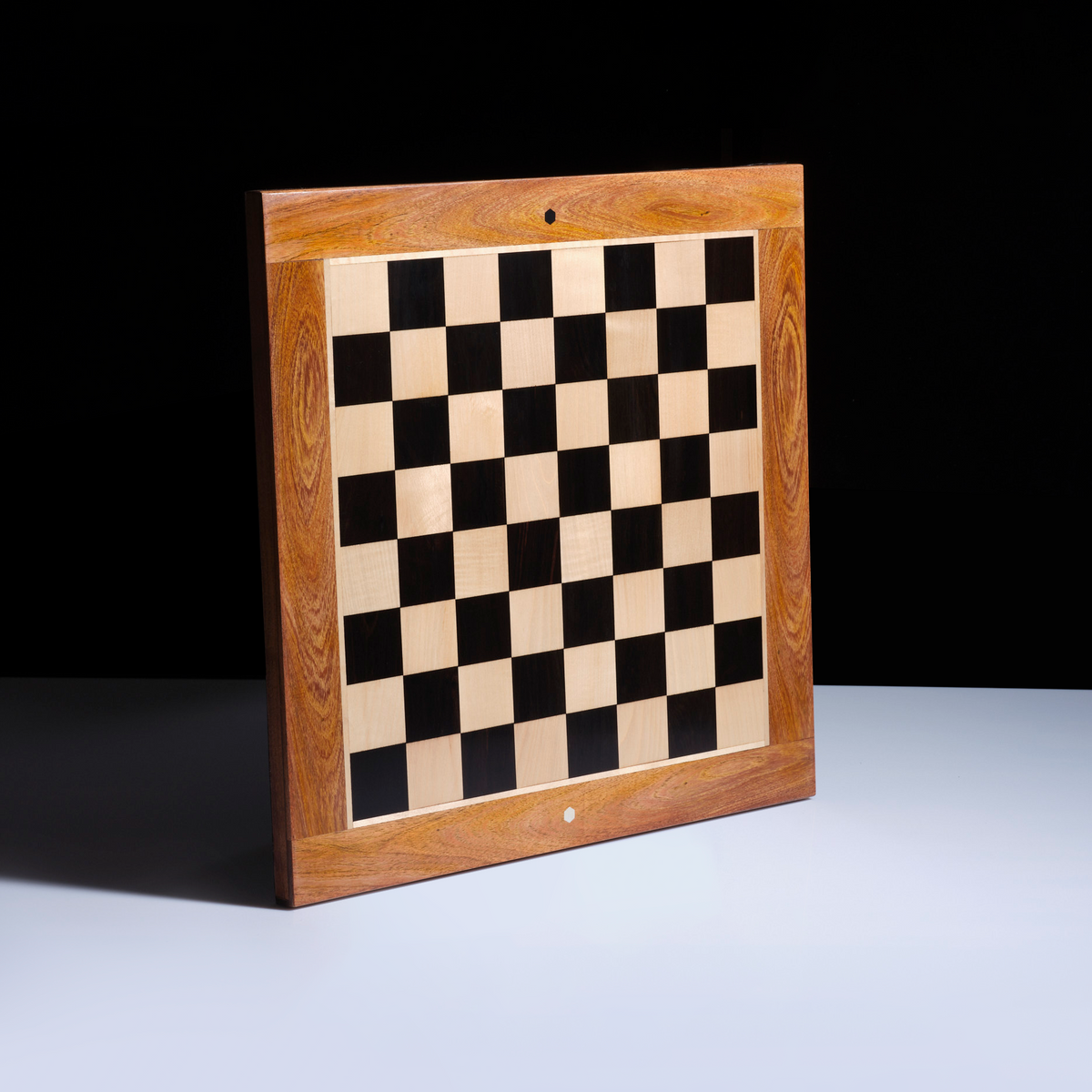
- Board sizes — The standard chess square size is 2–2.25 inches (5–5.7 cm), depending on whether the board is casual or tournament style.
| Use case | Square size | Typical king height | Notes |
|---|---|---|---|
| Travel | 1.5–2.0″ (3.8–5.0 cm) | 2.5–3.0″ | Compact and portable; keep good piece-to-square proportions. |
| Casual / Home | 2.0–2.25″ (5.0–5.7 cm) | 3.25–3.75″ | Comfortable viewing/handling; widest selection of boards. |
| Tournament / Club | 2.25″ (≈5.7 cm) | 3.75″ (±10%) | Most common pairing; piece base ≈40–50% of piece height. |
C
- Capture — Taking an opponent’s piece (x in notation).
- Center — The four central squares (e4, d4, e5, d5) and their surroundings.
- Check — A move that attacks the king.
- Checkmate — The king is attacked and cannot escape; game over.
- Classical chess — Longer time controls (e.g., 90+30).
- Clearance — Vacating a square/line for another piece or tactic.
- Counterplay — Creating threats while defending.
D
- Decoy — Luring a piece/king to a bad square.
- Deflection — Forcing a defender to leave a key task.
- Development — Bringing pieces into play efficiently.
- Discovered attack — Shifting one piece to expose the attack of a second piece.
- Doubling rooks — Two rooks on the same file/rank for pressure.
E
- Endgame — Phase with reduced material; king activity matters most.
- En passant — Special capture when a pawn moves two squares and passes a capture square.
- Equalize — Leveling the position as Black in the opening/early middlegame.
- Exchange (the exchange) — A rook against a bishop or knight; you “win” or “sacrifice” the exchange.
F
- Fianchetto — Developing a bishop to b2/g2/b7/g7.
- File — A vertical column (a–h).
- Fork — Two or more targets are attacked with a single piece. “Nf7 forked king and rook.”
- Fortress — A structure the opponent cannot break through.
G
- Gambit — Sacrificing material (often a pawn) for initiative.
- Good knight vs bad bishop — A knight outplays a bishop hemmed in by its own pawns.
H
- Hanging piece — An undefended piece that can be captured.
- Hole (weak square) — A square that cannot be guarded by pawns (e.g., d5 in many structures).
- Hybrid event — Players sit at real boards in different cities, moves are relayed online, arbiters supervise on site.
I
- Initiative — The right to make threats that must be answered.
- Interference — Inserting a piece between two attacking/defending lines.
- Isolated pawn (IQP) — A pawn that has no friendly pawns on nearby files.
K
- King safety — Minimizing risk to your king.
- Kingside / Queenside — The e–h half of the board (the king’s side) and the a–d half (the queen’s side).
L
- Line (open/half-open) — A file/diagonal for rooks/bishops/queen.
- Lock — Fixing a structure (e.g., closed center).
M
- Material — The sum value of pieces.
- Minor piece — Bishop or knight.
- Mating net — A pattern that traps the king.
- Model game — An instructive example to learn a theme.
N
- Novelty (TN) — A fresh move in well-known theory.
- NN — “No name”: an unidentified player in old game collections and databases.
O
- Open file — No pawns on a file; rooks love them.
- Opposition — Kings facing each other with one square between them; the side not to move holds it. A key endgame idea.
- Outpost — A strong square for a piece, especially a knight shielded by pawns.
P
- Passed pawn — A pawn with no enemy pawns to stop its advance.
- Pawn storm — Advancing pawns toward the enemy king.
- Perpetual check — A series of checks the opponent cannot escape; the game ends in a draw.
- Pin — If a piece moves, it exposes a more valuable piece or king.
- Prophylaxis — Preventing the opponent’s plan.
- Promotion — A pawn reaching the last rank becomes a queen, rook, bishop or knight.
- Puzzle rush — Solving as many tactics as possible against the clock, a popular online training mode.
Q
- Quiet move — A non-forcing move that improves position or creates a hidden threat.
R
- Rank — A horizontal row (1–8).
- Resign — Concede the game when the position is hopeless.
- Rook lift — Rook swings up the rank and across to attack (e.g., Re3–Rg3).
S
- Sacrifice (sack) — Giving material for time/attack/structure.
- Skewer — Placing a piece of greater value in front of one of lesser value.
- Space — Greater mobility and territorial control.
- Stalemate — The side to move has no legal move and is not in check; the game is drawn.
- Structure — Pawn formation that shapes plans.
- Swindle — Turning a lost position around via trick/resourcefulness.
T
- Tempo — A “move’s worth” of time; gaining/losing tempo.
- Tension — Unresolved captures/pressure in the center or on a wing.
- Tiebreaks — Rapid and blitz games that decide a match or tournament that ended level.
U
- Underpromotion — Promoting to a piece other than a queen (often a knight).
- Unpin — Breaking a pin, often by moving the pinned piece or interposing.
V
- Variation — A sequence of moves; in openings, a named line.
- Visualize — To calculate by “seeing” moves in your head without touching the pieces.
W
- Weakness — A square, pawn, or piece that is hard to defend.
- Windmill — A repeated discovered check that wins material on every turn of the wheel.
Z
- Zugzwang — Any move worsens the position; common in endgames.
- Zwischenzug (in-between move) — An unexpected intermediate move with tempo.
Want to put terms into action? Try these reads next: how to win in chess and best chess openings for White. For hands-on practice, set up a home board with a tournament chess set and a digital clock.
Common Chess Terms for Beginners
A quick-start set of common chess terms every learner should know, especially if you are building your chess terminology for beginners step by step:
| Term | Definition | Example |
|---|---|---|
| Check | Your king is attacked; you must respond | …Qh4+ forces a king move or block |
| Checkmate | King is attacked and cannot escape | Back-rank mate with …Re1# |
| Capture | Taking an opponent’s piece | Bxe5 wins a pawn |
| Develop | Bring pieces into play | Nc3, Bc4, 0-0 |
| Castle | King + rook move for safety/rook activation | 0-0 or 0-0-0 |
| Stalemate | No legal moves; not in check → draw | King blocked, side to move has no moves |
| Promotion | Pawn reaches last rank and becomes a piece | a8=Q |
| En passant | Special pawn capture after a double-step | exd6 e.p. |
More step-by-step primers: beginner chess strategy and how to win chess in 10 moves.
Slang and Club Talk
This is the fun chess lingo you’ll hear from streamers and club players — a natural part of chess jargon:
- Boom! — A flashy tactic or winning shot just landed.
- Brilliancy — An exceptionally beautiful game or move.
- Engine move — A computer-like resource humans rarely find.
- Flagging — Winning on time in blitz.
- Hot square — A square both sides fight over constantly.
- Mouse slip — Online misclick (“oops”) in digital play.
- Sack — Short for sacrifice.
- Tilt — Playing worse after a bad loss; emotional slide.
Chess Phrases and Expressions
Common chess phrases you’ll hear from coaches and commentators (and why they matter):
- “Passed pawns must be pushed.” — In many endgames, advancing a passed pawn creates winning chances.
- “Don’t bring your queen out too early.” — Queens that are overextended may lose tempi and be pursued.
- “A knight on the rim is dim.” — Knights are usually strongest near the center.
- “Open files belong to the rooks.” — Activate rooks on open/half-open files.
- “The threat is stronger than the execution.” — Pressure can be more valuable than immediate capture.
Bring these to life on a real board: how to set up a chess set and explore chess boards and chess pieces built to tournament sizes.
How to Learn Chess Terminology Faster
Level up your chess terms faster with habits that stick:
- Make mini-cards — Write a term + a 1-line example (e.g., Fork — Nf7! forking K+R).
- Practice with puzzles — Apply terms in tactics every day (10–15 mins).
- Play & annotate — After each game, label what happened: pin, skewer, pawn break.
- Watch commentary — Pause streams and explain a plan in your own words.
- Use training tech — Explore chess computers to analyze positions and drill motifs.
- Solo training — Ideas in how to play chess by yourself help you rehearse terms at your pace.
Take It to a Real Board
Most of these terms make more sense with pieces in hand. The shop has everything the list refers to:
- Tournament-Approved Chess Sets — Championship-style sets for training and club play.
- Premium Chess Pieces — Weighted pieces with great board feel.
- High-Quality Chess Boards — Durable boards with proper square sizes.
- Digital Chess Clocks — Essential for practical training and faster time controls.
- Chess Computers — Electronic boards and analysis tools for structured self-study.
- Chess Gifts & Collectibles — Celebrate milestones and favorite events.
Questions About Chess Terms
What are chess sayings?
Simple, easy to remember chess phrases such as “Passed pawns must be pushed”, “A knight on the rim is dim”, and “Open files belong to rooks” are used to convert the complicated strategy to common language. Historical overviews and terminology context see Encyclopaedia Britannica – Chess.
What are the words used in chess games?
The major chess words are check, checkmate, capture, castle, promotion, fork, pin, skewer, gambit and endgame. See the common chess terms above and A-Z chess glossary.
What are the most important chess terms?
For beginners: check, checkmate, fork, pin, skewer, open file, passed pawn, opposition. For improved: add prophylaxis, pawn break, exchange sacrifice, zugzwang, zwischenzug.
What is the oldest chess term?
Such historical terms as gambit and checkmate are centuries old and can be found in the earliest works of chess, translations of Persian/Arabic material, and later European.
What are 21 moves in chess?
There’s no official rule or concept called “21 moves.” From the starting position, White has 20 legal first moves (16 pawn moves + 4 knight moves). Some articles use “21 moves” informally (e.g., click-bait titles), but it’s not part of standard chess terminology.
What is the 75-move rule in chess?
Under the FIDE Laws of Chess a game is drawn automatically after 75 consecutive moves by each side without a capture or a pawn move. The better-known 50-move rule lets a player claim the draw earlier; the 75-move rule ends the game whether anyone claims or not.
What is the standard chess square size?
It’s 2–2.25 inches (5–5.7 cm), with 2.25″ most common for club/tournament boards.
Speaking the Language
Learning chess isn’t only about memorizing lines; it’s about speaking the game’s language fluently. Keep this chess terms list close as your everyday chess glossary. Apply new chess phrases in analysis, use the chess lingo you pick up from coaches and streams, and your understanding will jump quickly. For next steps, try how to get good at chess and explore practical winning ideas in how to win in chess — then bring it to the board.