· Paul Chessini · 8 min read
Chess Set Sizes, Explained: King Height, Square Size and the 75 Percent Rule

Here is a thing that happens in chess shops, online and off. Someone buys a handsome board, then a handsome set of pieces, and the two arrive and look, together, slightly wrong. The king towers over his square like a man in a child's chair, or the pawns rattle around with room to spare, and nobody can say exactly why the whole thing feels off, only that it does. The reason is arithmetic. A chess set has two numbers that matter, and when they do not agree, no amount of walnut will fix it.
The two numbers are the height of the king and the width of a square. Everything else about a set, the wood, the weight, the price, the little felt on the bottom, is negotiable. These two are not. Get them right and a $49 plastic set plays like a serious instrument. Get them wrong and a $2,000 one plays like furniture.
The rule: a king's base should cover about three quarters of a square
Pick up a king and look at its base, the disc it stands on. Put it in the middle of a square. The base should take up roughly 75 to 80 percent of the square's width, leaving a thin margin of board visible on each side. That is the whole rule, and it has been the whole rule since the Victorians standardised the Staunton pattern. The US Chess Federation writes it into its equipment guide as a number; FIDE arrives at the same place from the other direction, with a cruder and more memorable test: four pawns should fit on one square.
Why this ratio and not another? Because a chess position has to be read, not just assembled. At 75 to 80 percent the pieces sit close enough to look like an army and far enough apart that your eye can tell a bishop from a pawn two ranks away, and your hand can pick up a knight without knocking over its neighbours. Go tighter and the board looks crowded and plays nervously; go looser and the pieces look lost, which is the single most common fault in decorative sets sold as "luxury."

The numbers that go with it
If you want to skip the ratio and work from a table, here is what the rulebooks and the trade have settled on.
| Use | King height | Square | Board across |
|---|---|---|---|
| Tournament and club (FIDE, US Chess) | 9.5 cm / 3.75 in (US Chess allows 3.375–4.5 in) | 5–6 cm / 2–2.5 in | 50–55 cm / 20–22 in |
| Home, full size | 9–9.5 cm | 5 cm | 45–50 cm |
| Home, compact | 7.5–8.5 cm | 4–4.5 cm | 36–42 cm |
| Travel and analysis | 5–7 cm | 2.5–3.5 cm | 25–32 cm |
FIDE's current equipment standard asks for squares between 5 and 6 centimetres and a king of about 9.5 centimetres, Staunton pattern, weighted so that it does not tip when a hand brushes it. A square of 5 centimetres with a 9.5 centimetre king is the combination used at the World Championship and at nearly every event where the result goes on a rating list. It is also the size the professionals' hands know. Watch a grandmaster at a club board and you will see them reach for a piece without looking; the distances are muscle memory.

Height is not the only number on a piece
Sellers quote king height because it is one figure and it sounds like a specification. It is a start. But the same 9.5 centimetre king can stand on a 36 millimetre base or a 45 millimetre one, and that difference decides which board it belongs on. The second number, often missing from product pages, is the base diameter; the third is weight. A king of 9.5 centimetres that weighs 25 grams will fall over when the table is bumped. One that weighs 50 grams, weighted with lead in the base, sits through a blitz game. The World Chess king is 95 millimetres tall, 39 millimetres across the base and 54 grams, which is why it stays upright in time trouble and why it belongs on a 50 millimetre square and nothing smaller.
When you shop, look for all three. If a listing gives you height only, write and ask. A seller who cannot tell you the base diameter of a king has not measured it, and a set nobody has measured is a set nobody has tested.
Which size for which room
The tournament size is the right answer more often than people expect, and the wrong answer in a way that is easy to underestimate. A 50 centimetre board needs a table about 70 centimetres deep so that two players have somewhere to put their elbows, their clock and their coffee. A dining table does it. A coffee table does not, and a 50 centimetre board on a coffee table is how a beautiful set ends up living in its box.
For a flat, the honest choice is a compact board that keeps the ratio. A 38 to 42 centimetre board with 4.5 centimetre squares and a king of around 8 centimetres has the same proportions as the stage set and fits a side table. That is the logic of the Studio Set and the Home Editions: 87 percent of tournament size, the same silhouette, the same margin of board around each base, scaled so the whole thing closes into something you can put on a shelf.
For travel the ratio gives way to practicality. The pieces have to stay put and the board has to fold, so travel sets run small, 25 to 32 centimetres, and rely on magnets or pegs. Nobody analyses a Sicilian on a plane in tournament proportions, and nobody should try.

The mistakes, in order of how often we see them
Buying the board by its outside measurement. A board sold as "21 inches" might have 2.25 inch squares or 2 inch squares, depending on how wide its border is. The number that matters is the square. Ask for it, or divide the playing area by eight.
Buying pieces and board from different places without checking the ratio. This is the source of most mismatches. A 4 inch king from one maker and a 2 inch square from another add up to a base covering 90 percent of the square: a crowded board that plays badly. If you buy separately, measure the base first.
Mistaking tall for serious. Oversized kings, 4.25 or 4.5 inches, look impressive in a photograph and need 2.5 inch squares and a 24 inch board, which almost nobody has room for. The tournament standard is 3.75 inches for a reason.
Buying a child a child-sized set. Small boards are harder to play on, not easier. A child learning the game does better on tournament-size pieces, which are easier to grip and read; the weighted plastic Academy set exists for exactly this, and it is what schools order by the box.
How the World Chess sets line up
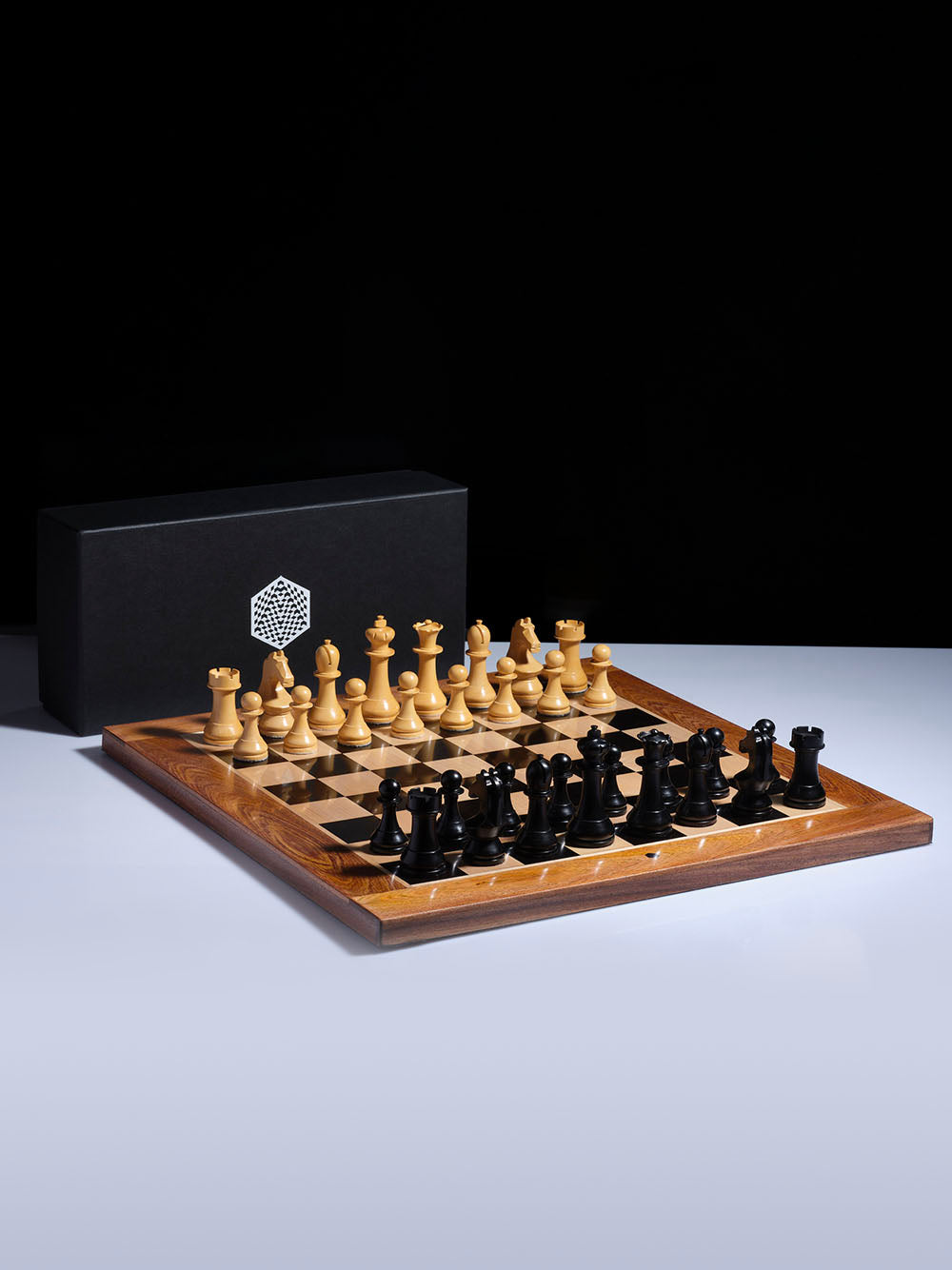
Every set we make is built to the ratio, so the table below is as much a guide to sizes in general as it is to our range. Full-size editions take the FIDE-approved pieces, 9.5 centimetre king, 39 millimetre base, on 5 centimetre squares; the compact editions scale both numbers together.
| Set | King | Square | Board | Where it lives |
|---|---|---|---|---|
| World Championship set: Walnut, Wenge, Rosewood, Premium | 9.5 cm, 54 g | 5 cm | 50 × 50 cm | Club, tournament, a table of its own |
| Academy Edition, weighted plastic | 8.6 cm | 4.8 cm | 44 cm, folding | School, club, rated play, first set |
| Studio Set | 7.9 cm | 4.5 cm | 38 × 38 cm, folds to a book | Flat, office, shelf |
| Home Editions | scaled with the board | 4–4.5 cm | 38–40 cm | Living room, coffee table |
| Pieces alone | 9.5 cm, 54 g | needs 5 cm | your board | For a board you already own |
If you already have a board, measure one square before you buy pieces; if you already have pieces, measure the king's base and multiply by 1.3 to get the square you need. If you have neither, buy them together from the same maker and let someone else do the arithmetic. The full range of chess sets is sorted so that the first page is what is in stock now; the boards are all cut for 5 centimetre squares unless the listing says otherwise.
Questions people ask
What is the standard chess set size?
For tournament play: a king of 9.5 cm (3.75 in) on squares of 5 to 6 cm (2 to 2.5 in), which means a board of about 50 cm (20 in) across. Most serious home sets use the same numbers or scale both down together.
How big should a chess board be for 3.75 inch pieces?
Squares of 2 to 2.25 inches (5 to 5.7 cm), so a playing area of 16 to 18 inches and a board of 20 to 22 inches with its border. The base of a 3.75 inch king is usually about 1.5 to 1.75 inches, and the base should cover 75 to 80 percent of the square.
What size chess set do grandmasters use?
The tournament size: 9.5 cm king, 5 cm squares. The World Championship has been played on exactly those numbers, with the World Chess pieces, since 2013.
Is a bigger chess set better?
Only up to the tournament size. Beyond a 3.75 inch king the board grows faster than the benefit, and a 24 inch board needs a table most homes do not have. Oversized sets are for display.
Can I use tournament pieces on a smaller board?
Down to about 4.5 cm squares, yes, if you accept a slightly crowded look. Below that the king's base covers the square and the position becomes hard to read. For boards under 42 cm, buy pieces scaled to them.